


$0.00


0
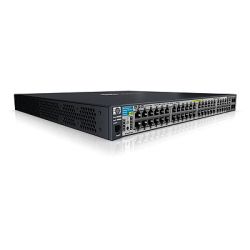
Manufacturer: HP
Part Number: J9311A#ABA
UPC: 884962722794
Thinking of making a large purchase?
HP HP ProCurve 3500yl-48G-PoE+ Layer 3 Switch
BACKORDERED
Estimated Delivery with free shipping by:
Backordered - ETA Unknown
* If ordered today with free shipping.
Features
Specification
| Address table size | 64000 entries |
|---|---|
| Compatible Rack Unit | 1U |
| Ethernet Technology | Gigabit Ethernet |
| Expansion Slot Type | SFP |
| Flash Memory | 4 MB |
| Form Factor | 1U height |
| Form Factor | Rack-mountable |
| Height / Width / Depth | 1.7" / 17.4" / 16.9" |
| Input Frequency | 50/60 Hz |
| Input Operating Current | 7.3/3.3 A |
| Input Voltage | 100 - 127 / 200 - 240 VAC |
| Input Voltage | 110 V AC / 220 V AC |
| Layer Supported | 3 |
| Limited Warranty | Lifetime |
| Manageable | Yes |
| Management | HP ProCurve Manager Plus / IEEE 802.1p QoS / IEEE 802.1Q VLAN / CLI |
| Management | Web Based Management / RMON / DHCP / SNMP v1, v2c,v3 / Telnet |
| Management features | HP PCM+; HP PCM (included); command-line interface; |
| Management features | Web browser; configuration menu; out-of-band management (serial RS-232C) |
| Manufacturer Warranty | Lifetime, advance replacement, next business day |
| Memory Technology | DDR SDRAM |
| Network Technology | 10/100/1000Base-T |
| Number of Network (RJ-45) Ports | 44 |
| Number of PoE (RJ-45) Ports | 4 |
| Number of SFP Slots | 4 |
| Number of Total Expansion Slots | 5 |
| PoE (RJ-45) Port | Yes |
| Port/Expansion Slot Details | 44 x Gigabit Ethernet Network / 4 x Gigabit Ethernet Expansion Slot |
| Ports | 1 open module slot; 44 autosensing 10/100/1000 ports (IEEE 802.3 Type 10BASE-T, |
| Ports | IEEE 802.3u Type 100BASE-TX, IEEE 802.3ab Type 1000BASE-T);Media Type: Auto-MDIX;Duplex: |
| Ports | 10BASE-T/100BASE-TX: half or full; 1000BASE-T: full only; 1 RJ-45 serial console port; |
| Ports | 4 dual-personality ports;each port can be used as either an RJ-45 10/100/1000 port (IEEE 802.3 Type |
| Ports | 10BASE-T; IEEE 802.3u Type 100BASE-TX; IEEE 802.3ab 1000BASE-T Gigabit Ethernet) |
| Ports | with PoE or an open mini-GBIC slot (for use with mini-GBIC transceivers); |
| Ports | Supports a maximum of 4 10GbE ports, with optional module; Included |
| Power consumption | 638 W (maximum) |
| Power features | The switch automatically adjusts to any voltage between 100-127 and 200-240 V w/ either 50 or 60 Hz. |
| Power Source | Power Supply |
| Product dimensions (W x D x H) | 17.44 x 16.93 x 1.73 in |
| Redundant Power Supply | Yes |
| Shared SFP Slot | Yes |
| Standard Memory | 256 MB |
| Total Number of Network Ports | 48 |
| Warranty | Lifetime, advance replacement, next business day |
| Weight ( Imperial ) | 15.54 lb |
| Weight ( Metric ) | 7.05 kg |
| Weight (Approximate) | 15.54 lb |


